Why UV Camera Lenses are the New Standard in Forensic Science
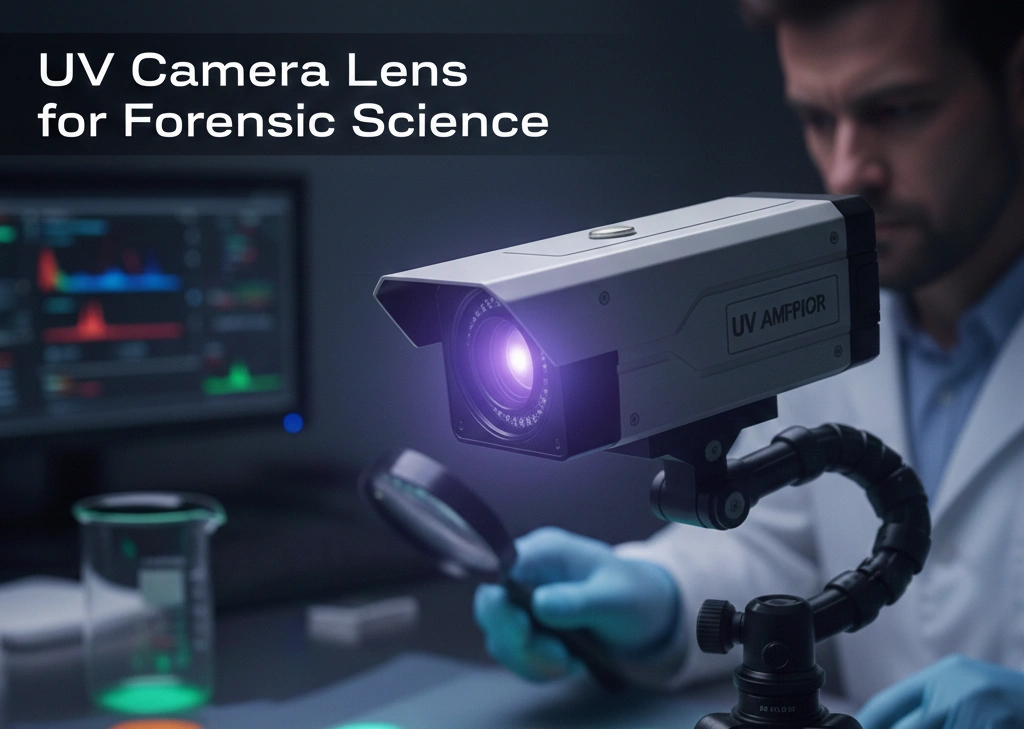
The field of forensic science often requires a vision that extends beyond the visible spectrum. Which is why the UV camera lens has become a standard in this field. The use of the Ultraviolet camera offers numerous applications in forensic science. Especially in the time for evidence collection, or say to track or identify “invisible evidence.” Including the latent prints, biological traces, or even an altered document, which is impossible to view with the naked human eye. The standard lenses fall short in this field due to their build quality. They are specialised for the visible light spectrum and perform best in it.
Therefore, a standard surveillance setup might capture the act, but it often misses the trace of evidence left behind. Meanwhile, the UV camera lens is designed to capture images in the 200-400 nm spectral range. Making the lenses ideal for forensic teams, so they can visualize evidence that standard glass optics would absorb and block. Let’s dive deeper to understand why forensic labs and advanced security teams are upgrading their optical hardware to include UV capabilities.
What Makes The UV Cameras More Suitable for End-to-End Capturing
What makes a huge difference between UV Cameras and standard cameras is their build quality. From the materials used to the camera’s specifications, everything makes a significant difference. Making the CCTV lens a single camera that captures an image in a spectral range invisible to the human eye. The other can only capture imaging for 24/7 surveillance.
The standard lens’s construction includes regular glass optics that absorb ultraviolet radiation, which can blind the sensor. The range is below 350nm, enabling evidence capture in that spectrum. The camera sensor cannot detect UV evidence, meaning subtle forensic details ( like certain stains, markings/ or chemical traces) remain invisible. Conventional surveillance systems miss critical layers of information.
The specialized UV camera lens is made of quartz and fused silica, engineered for high UV transmission. Therefore, these lenses allow UV light in the 200-400 nm range to pass through easily, enabling the capture of UV-specific evidence. It also reveals details that are invisible under normal light. Using UV cameras, investigators can access a hidden spectrum of data that is critical to solving cases and gathering evidence. It enhances forensic accuracy, enabling evidence to be obtained twice as fast.
| Feature | Glass CCTV Lens | Quartz/Fused Silica UV Lens |
|---|---|---|
| Material | Standard optical glass | Quartz or fused silica |
| UV Transmission | Poor (absorbs UV, especially <350nm) | Excellent (200–400nm range passes through) |
| Evidence Capture | Limited – UV details invisible | Enhanced – reveals hidden forensic/chemical traces |
| Use Case | General surveillance | Forensic/security investigations needing UV spectrum |
Critical Applications in Forensics and Law Enforcement
The CCTV lens retracts when a critical investigation begins at a crime scene. The camera can only catch the culprit if they come into its vision. However, it is insufficient to capture the traces left behind by the UV lens steps to uncover the truth. Here’s how it helps forensics teams.
1. Detecting Invisible Fingerprints
Finding a fingerprint on a cluttered surface can be a hassle for investigators. Therefore, they use the superglue fuming process (which causes fumes to adhere to the surface), and UV light helps reveal traces of it on a light-colored background by illuminating the surface.
2. Spotting Forgeries
It identifies counterfeit documents and forgeries made by criminals. To the naked eye, ink can look the same, but under UV light, it is very different. Therefore, UV optics are best suited to catch these fakes. Under UV light, one ink may completely disappear while the other turns pitch black, making identification quick and effective. Also, these CCTV lens is used for passport and money verification.
3. Finding Biological Evidence
One of the most valuable applications of UV imaging is at a crime scene that has been cleaned. It helps in identifying biological fluids such as saliva, blood, and sweat, as they contain proteins that naturally glow (fluoresce). As soon as it hit the UV light. Even on washed carpets, tiny fluid traces remain deep within the fibers, aiding identification. It allows investigators to scan a room quickly and identify these glowing spots.
Summing It Up!
Optical solutions that make work easier and enable vision in high-stakes environments, such as forensic and scientific analysis, save significant time. A UV camera lens is a perfect example of this. It captures images impossible to see with a standard camera. Therefore, it has high requirements in such a field that requires critical care of the surroundings. Ultraviolet lenses are essential for evidence collection and trace tracking in forensic investigations. Relying on standard cameras can really exaggerate the simple task and take time, which is evident within seconds using ultraviolet rays.
So change your optics and see the invisible. Whether you’re in forensic teams, lab managers, or even industrial integrators. The superior CCTV catalog is the best place to find the latest products that will suit our preferences.
FAQs
A standard lens is designed to block UV rays to protect image quality and produce high-resolution images in daylight. In contrast, the UV camera lenses are made of quartz or fused silica and are specifically designed to transmit ultraviolet light to the sensor for specialized imaging. It is used in applications like forensics and industrial inspection.
You can physically mount the lens if the mount type is C-mount or CS-mount, which allows for adaptability. However, standard camera sensors often have built-in UV cut filters that might disrupt the experience. To achieve results, you must use a camera sensor and lens specifically designed to be sensitive to the UV spectrum.
Yes, SuperiorCCTV specializes in a wide range of optical solutions to meet diverse needs. We carry lenses optimized for visiblelight,near-infrared for night vision, and deep ultraviolet UV applications. So the client can match the correct optic to their specific industrial or security requirements without compromise.
Quartz is used because standard optical glass absorbs ultraviolet light, making it impossible to capture UV images. Quartz (or synthetic fused silica) allows UV light to pass through to the sensor with minimal loss, ensuring high-contrast, clear images for scientific and forensic analysis.
Absolutely, we have our own R&D facilities where we manufacture the best optical products that suit all client preferences and meet their needs. Our support team can connect with you to discuss your specifications and customize the product to meet your needs.