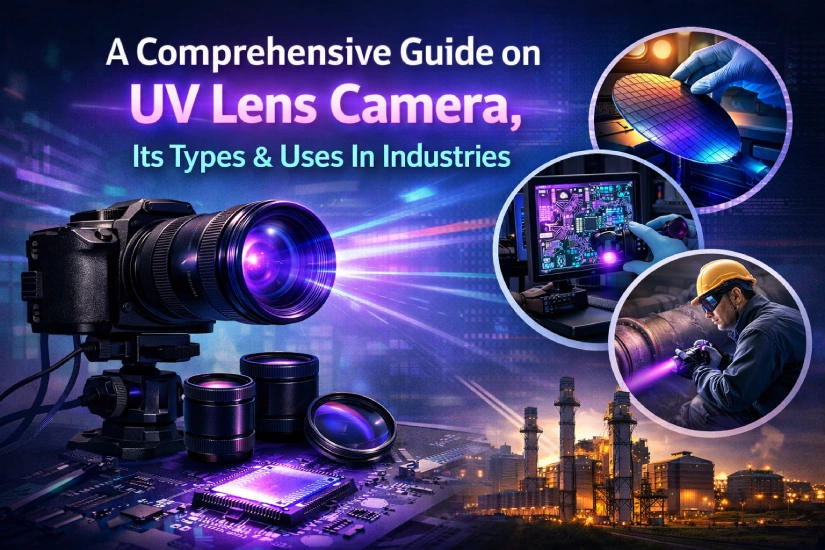
A Comprehensive Guide on UV Lens Camera, Its Types & Uses In Industries
The lens used to capture the imaging in the ultraviolet spectrum is a UV camera lens. It is an optical object that captures a high-quality image and views the target as expected during the shot. This lens is custom-made by fitting the glass piece into a plastic frame, which comes in various sizes. Moreover, these ultraviolet camera lens protect your camera lenses from small environmental hazards, such as scratches, sand, sea spray, dust, and cuts. These ideal lenses allow us to capture details invisible to the human eye. Therefore, they are used in various fields, including forensics, art restoration, and scientific research.
Furthermore, they reveal bruises and detect forgeries in documents, as the UV lens filter enhances image clarity by blocking haze and protecting the lens. In this blog post, we will explore ultraviolet photography in more detail.
What are Ultraviolet Lenses for a Camera & Their Types?
A UV Camera is designed to operate efficiently by capturing images in the ultraviolet spectrum, ranging approximately from 10 nm to 400 nm. Unlike the standard camera, which captures images within the visible light spectrum, a UV camera lens uses its specialized filters. Along with a sensor for UV detection, this allows it to visualize fluorescence and material properties that are not visible under normal lighting.
In terms of health, it helps identify skin conditions such as hidden bruises and abnormalities, and also indicates evidence of injury. In society, ultraviolet camera lens supports art conservation (identifying art deterioration) and law enforcement (helping in identifying forged documents). In the environment, monitors plant health and pollution.
The UV Lenses have a few types. Let’s explore them.
1. Monochrome UV Cameras
The monochrome camera from UV camera lens is highly sensitive to UV light and effectively captures high-resolution images and 1080 HD videos. It is six times more sensitive to light than an RGB monochrome sensor. It is mainly used in scientific research and industrial applications.
2. UV-Only Cameras
A ultraviolet camera lens is modified to enhance UV sensitivity by removing the color filter array. This results in better performance in low-light conditions. The UV-only camera quickly scans an area for UV information using its live view feature.
3. Standard Cameras with UV filters
Some standard cameras are equipped with UV filters for camera lenses, so they can capture UV images. Although they may not be as effective as dedicated UV cameras.
Primary Use of UV Camera Across Various Industries
The ultraviolet camera has applications across many industries, as it is highly effective and simplifies the identification of many aspects. This application shows the versatility and importance across different fields.
1. Scientific Research
A UV camera lens plays a major role in scientific research, as it captures images in the UV spectrum. This reveals information and qualities invisible to human eyes, leading to new discoveries. For example, a UV camera detects the fluorescence emitted by certain minerals, supporting geology and environmental monitoring.
2. Security and Surveillance
The ability to capture high-quality imaging, even in low-light conditions, leads to the extended use of UV camera lens in security surveillance. It can also identify fraudulent currency and forged documents through its unique properties. The FBI also stated that UV camera technology is vital for protecting against fraudulent activities.
3. Art Restoration
Analyzing the artwork with UV cameras is crucial. It helps conservators identify underlying paint or varnish layers. Also, it identifies previous restoration attempts that cannot be seen in normal light. The ultraviolet camera lens ensures that artifacts retain their historical integrity.
4. Forensic Investigation
In investigations, the UV camera is an important tool due to its high speed and long-distance capabilities. They effectively detect bodily fluids or evidence that is difficult to detect with the naked eye. Furthermore, this ability of the UV camera lens to identify hidden materials is very helpful to investigators gathering information and obtaining critical evidence.
5. Biomedical Field
The UV cameras are used for diagnostic purposes in the field of biomedicine. It supports the thorough examination of multiple skin conditions by revealing changes that are invisible under standard lighting. Even studies show that UV camera lens imaging is effective at detecting early-stage skin cancers, enabling timely treatment.
How Does The UV Filter Lens Affect Image Quality?
The significant growth in UV filters for camera lenses has been driven by rising demand for camera equipment. As the popularity of photography and videography has risen, so has the demand for camera lenses in industries such as surveillance, healthcare, and automotive.
UV lens filter can block ultraviolet light, preventing haze and color washout, and resulting in sharper detail and more accurate tones. Especially during outdoor or high-altitude photography. It also reduces flare and ghosting by minimizing reflection for natural vibrancy and contrast in the image. Let’s look at some of the UV lens filter types:
UV Blocking: 99.90% for each type of filter lens.
| UV Filter | Thickness | Frame Material | Key Features | Best For |
|---|---|---|---|---|
| Tiffen UV Protection Filter | 3mm | Aluminum | Multicoated, scratch-resistant, reduces reflections & glare | Affordable, reliable everyday protection |
| Hoya UV(C) Filter | 4mm | Aluminum | High-quality glass, multicoated, reduces haze & flare | High-contrast outdoor shooting |
| B+W UV Filter | 3mm | Brass | Premium build, multicoated, excellent optical clarity | Professional photographers need durability |
| Kenko UV Filter | 3mm | Aluminum | Slim design, multicoated, scratch-resistant | Budget-friendly option with solid performance |
| Sigma UV Filter | 3mm | Aluminum | Multicoated, reduces flare & ghosting, durable glass | Balanced choice for quality & value |
Final Words!
The UV Camera lens unlocks a new vision that is not possible to capture with the naked human eyes or even with standard lenses. These lenses are used in critical industries, which is the reason for their sustainable popularity. Many studies from universities worldwide have also addressed its usefulness in their own fields, demonstrating the reliability of the ultraviolet camera lens.
So, if you want to integrate this into our system or own it for photography or videography. Look no further than Superior CCTV, which is a leading manufacturer of optics in Fujian, China. We provide all types of optics, with customization available. Whether you want a UV camera or a UV lens filter, we have it all.
FAQs
Ans: Yes, a UV lens filter enhances the imaging by reducing reflection and flare, helping maintain natural contrast and color accuracy in challenging light conditions.
Ans: It depends on personal choice, as many photographers keep UV filters for camera lenses permanently, as it not only enhances clarity. It also protects against scratches, dust, and moisture.