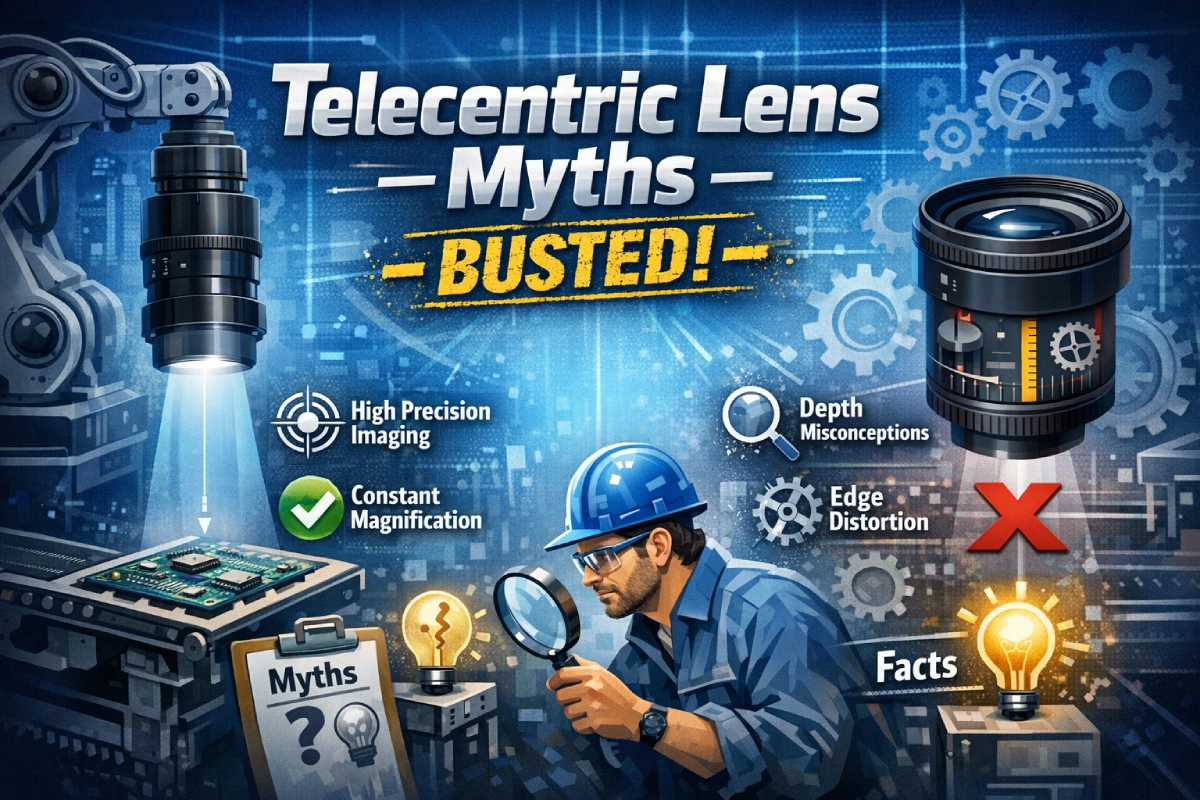
Standard Misconceptions to Avoid When Buying Machine Vision Telecentric Lens
As we all know, when it comes to security cameras, lens quality is a crucial factor that makes all the difference. Furthermore, whether you have installed a small home security camera or a professional-grade camera for the workplace, choosing the right machine vision telecentric lens is essential. Furthermore, in machine vision systems, image quality directly impacts the inspection accuracy, system stability, and measurement reliability. Additionally, while sensors and software receive the most attention, the industrial telecentric lens is often the most critical and least recognized component of a security surveillance camera.
Nevertheless, when choosing a machine vision CCTV lens, it is imperative not to overlook the common myths in the overall system. For instance, failing to account for environmental components can lead to suboptimal lens damage and performance. Likewise, failing to meet resolution and image quality needs can result in deficient image analysis and capture. Moreover, in this comprehensive blog, we will discuss some fundamental misconceptions to avoid when buying a telecentric machine vision lens. Thus, it is the best way to help buyers avoid common mistakes.
What is a Machine Vision Telecentric Lens?
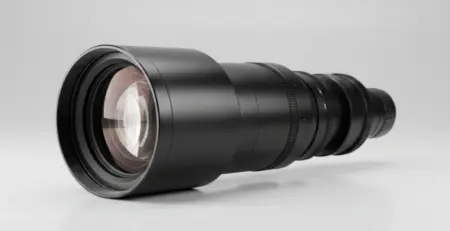
A machine vision telecentric lens is a specialized optical lens that keeps a constant magnification regardless of object depth or distance. Also, it eliminates parallax errors and perspective distortion. Unlike other conventional lenses, its chief rays are aligned parallel to the optical axis. It makes it ideal for high-precision gauging, alignment, and 2D/3D industrial measurements.
Vital Myths to Avoid When Buying Machine Vision Telecentric Lens
Buying a machine vision telecentric lens is the smartest choice, particularly if you need accurate measurement, inspection, or metrology. To be honest, so many myths are circulating in the market today, and as a result of not being aware of the myths, you may end up buying the wrong lens. Let’s get started by debunking the key myths you should avoid when buying a lens.
1. Myth: Telecentric Lenses are for High-End Labs Only
It is possibly the most common myth. The truth is that the use of telecentric lenses is not limited to research. Today, telecentric lenses are used in manufacturing, packaging, electronics, automotive part inspection, medical device inspection, and battery inspection.
If you require exact measurements of dimensions such as diameter, edge, gap, or hole spacing, a telecentric lens may be a practical necessity rather than a luxury. Nevertheless, this myth leads users to choose standard lenses, which then cause problems.
2. Myth: A normal lens + software correction is a replacement for a telecentric lens
Most people consider that the repair of the perspective distortion by software does not require a machine vision telecentric lens, but it is just an “approximation,” not a true telecentricity.
Normally, when a normal lens is used, the perspective error varies with object height. When a telecentric lens is used, the magnification remains the same (constant). At the same time, when the software corrects the image, edge repeatability is low.
3. Myth: Telecentric lenses always mean better image quality
The purpose of using telecentric lenses is to achieve accurate measurement and constant magnification, rather than image quality. While images can be sharper, they don’t have to be.
If you don’t get sensor size, resolution, lighting, aperture, and working distance right, the industrial telecentric lens can also fail to deliver. Therefore, it is important to note that having a Telecentric tag does not guarantee the image will be exceptional.
4. Myth: Field of View (FOV) will only be approximate
The term “approximate” in FOV for machine vision is undesirable. An exact FOV match is a key factor to consider when selecting a telecentric lens. For instance, if your part dimension is 60mm, your lens has a 55mm FOV, and you trim the edges, the measurement will be broken.
In the opposite case, when you have an unnecessarily high FOV, you waste your resolution. Telecentric lenses are not cheap, and every pixel counts. Don’t be too lax when you calculate your FOV.
5. Myth: Working distance (WD) is fixed and can be adjusted
Working distance appears to play a significant role in a telecentric machine vision lens. You can adjust focus on standard lenses by moving the camera slightly. However, telecentric lenses have a specific WD range, and you must operate within it.
If the design of the machine upon which you’re using WD does not permit it, the lens selection will be incorrect. Therefore, it’s highly recommended that you consider mechanical constraints before purchasing a lens, particularly mounting space, conveyor height, and part clearance.
6. Myth: Depth of Field (DOF) is always high
Everyone assumes that a telecentric CCTV lens has high DOF. However, the fact that DOF is a function of F-number, magnification, and resolution. Additionally, DOF can be increased using telecentric lenses, but it is not infinite.
In addition, even when part height variation is large or if there is an object tilt, the issue of DOF limitation will still exist. It’s necessary to verify the DOF values specified in the lens description. Otherwise, “measurement drift” may occur.
7. Myth: The lens will adapt regardless of sensor size
Using telecentric lenses is critical when matching lenses to camera sensors. Furthermore, you may lose FOV with smaller sensors or experience vignetting, dark corners, or soft-edged responses with larger sensors.
Typically, telecentric lenses are designed to meet specific image circle requirements. Hence, the sensor format pertaining to the lens image circle, whether 1/2″, 2/3″, 1″, APS-C, and others, remains an indispensable factor.
8. Myth: The cheapest telecentric lens is the best value
A telecentric CCTV lens belongs to the premium segment, and there are also “low-cost telecentric” options. However, the issue is that low-cost vision lenses often compromise on telecentricity, distortion, coating, and mechanical stability.
Moreover, the cost of those compromises in machine vision systems is simple: repeatability declines, false rejects rise, and downtime increases. Best value doesn’t necessarily mean the cheapest value. It means consistency and support, as well as specification correctness.
Final Words!
We hope this blog post has addressed the key myths you should avoid when purchasing a lens. Nonetheless, if you are looking for a reliable manufacturer to purchase a machine vision telecentric lens, look no further than Superior CCTV. We designed every CCTV camera lens with precision and advanced technology. Whether you want wide-angle camera lenses or clear capture lenses, we offer everything under one roof. Installed a highly-precision camera lens to secure your space today! Connect with our team and purchase camera lenses at the most competitive price.
Frequently Asked Questions
In comparison to regular lenses, the magnification provided by telecentric lenses remains constant even if the distance being focused on changes or the object being focused on moves. This special characteristic makes these lenses useful in critical applications.
Telecentric lenses are designed to maintain constant magnification regardless of the object’s distance from the camera or its position in the frame.
Here, we have listed the fundamental benefits of telecentric lenses that you must know:
- Consistent Magnification
- High Measurement Accuracy
- Low Distortion
- Enhanced Depth of Field
- Reduced Parallax Error
Choosing the right telecentric lenses depends on the end-to-end understanding of the application and the particular optical parameters involved. Moreover, here are the key factors to consider when purchasing it:
- Magnification
- Working Distance
- Sensor Size Compatibility
- Telecentricity Tolerance
- Field of View (FOV)