
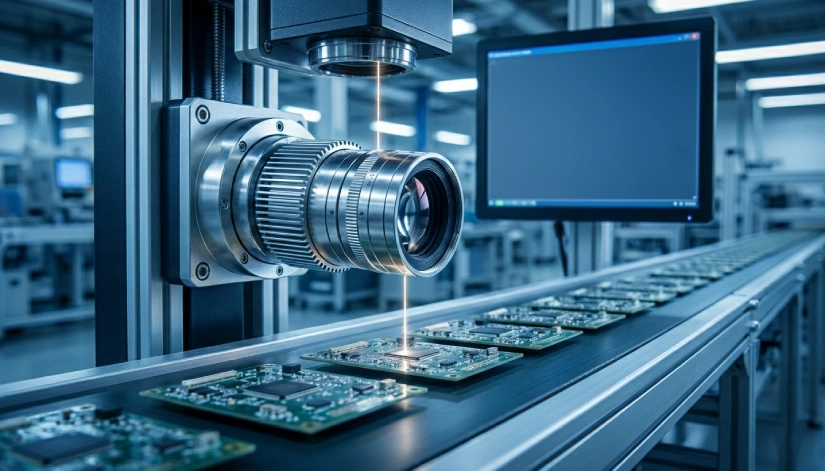
High-resolution Imaging and Other Benefits of a Line Scan Camera Lens
In diverse applications of ordinary lenses across industries, they exhibit limited image resolution and quality when capturing continuously moving or rolling objects. Therefore, ordinary security camera lenses cannot meet the needs of high-speed detection. Furthermore, using a line scan camera lens is one of the best solutions for capturing objects, whether far or near, at high resolution. Likewise, a line scan camera lens is a standard industrial vision device used to capture images of moving objects quickly.
Consequently, a conventional camera with line scan lenses uses a short exposure time and a scanning-like method to capture the entire image. Nonetheless, this scanning technique can help decrease the percentage of blurriness from moving objects and enhance image clarity. Moreover, the speed of a line scan camera lens is related to its line frequency.
What is a Line Scan Camera Lens?
A line scan camera lens is a specialized lens designed for line scan cameras, capturing high–resolution images of rapidly moving objects one thin horizontal “line” at a time. Furthermore, it stitches these lines together to create a complete picture and excels at industrial tasks, including inspection (PCB, web, and print), quality control, and measurement. Likewise, it occurs because of their ability to manage continuous motion, sharpness, and low distortion. Line scan lenses are optimized for use with extended line sensors and provide the precise details needed to identify flaws in fast-moving objects.
Benefits of a Line Scan Camera Lens That You Must Know
Significantly compared with standard industrial lenses, a line scan lens has some imperative advantages that every individual should know before planning to purchase it for machine vision inspection:
1. It Offers Super High-Speed Image Capturing Properties
The most significant advantage of a line scan camera lens is its ultra-fast image-capture capability. Furthermore, these lenses capture objects in continuous motion without blur. For example, if products are moving quickly on a conveyor belt, a line scan lens accurately captures every detail. Additionally, its speed is so high that even high-volume manufacturing lines can be easily inspected.
2. It is Perfect for Continuous Surfaces
When you need to inspect a long, continuous surface, such as textiles, paper, steel sheets, or printing rolls, a line scan lens is the best option. Also, they scan one line at a time, providing a seamless, distortion-free image of the entire surface. Normal area-scan cameras fail here, but line scan lenses deliver smooth results.
3. Offer Exceptional Image Resolution
A line scan camera lens typically offers high resolution, clearly highlighting even minute defects. Therefore, even the slightest scratch, pattern mismatch, printing defect, or fiber anomaly cannot escape the attention of these lenses. However, this feature is essential in industries such as electronics, pharmaceuticals, and packaging.
4. Provides High-Resolution Accuracy in Inspection
If precision is the most essential factor in a process, a line scan camera lens is unbeatable. Thus, it happens because they maintain constant lighting and consistent optical quality, resulting in highly accurate inspection results. They become a reliable tool for quality control teams.
5. Ideal for High-Resolution Sorting Systems
Line scan lenses are perfect for systems where sorting and grading must be done with high accuracy, such as fruit and vegetable sorting, grain inspection, or automatic quality grading. Moreover, the optical clarity and scan accuracy of the lens help systems make accurate decisions.
6. Consistent Lighting Compatibility
Line scan setups are typically used with bright, uniform lighting systems. Line scan lens efficiently utilizes uniform illumination, reducing shadowing and hotspots in images. Therefore, every scan looks crystal clear, making the inspection process more reliable and straightforward.
7. Durable and Industrial-Grade Build
Line scan camera lenses are designed for industrial-grade environments. It means a line scan camera lens can handle heat, vibration, dust, and extended operating hours without compromise. Likewise, equipment durability is crucial in manufacturing plants, and these lenses score full marks in this area.
8. Ideal for Defect Detection & Classification
The clarity and ability to capture detail of a line scan lens make it perfect for defect detection. However, whether it’s a printing error, a surface crack, a color inconsistency, an alignment issue, or a pattern deviation, they’re instantly detected. When integrated with advanced machine vision systems, they enable automated defect classification.
9. Better Control Over Motion and Timing
Line scan camera systems are finely synchronized with the motion, timing, and speed of the object.Thus, a line scan camera lens design supports systems in which timing mismatches can cause image defects. Nevertheless, this synchronized performance ensures that even high-speed processes remain smooth and accurate.
10. Enhanced Field of View (FOV)
The field of view of these lenses is quite flexible. Moreover, you can use them for inspecting narrow objects or wide industrial sheets. Likewise, the field of view (FOV) can be customized to suit the system’s requirements, which makes it highly versatile and durable.
11. Perfect Choice for Industrial Automation
Reliability is a key factor in the world of automation. Hence, the stable performance of line scan lenses makes them an excellent fit for industrial automation. Robots, conveyor systems, sorting lines, and inspection units all coordinate perfectly with these lenses. Additionally, the more complex or high-speed workflows you use them in, the more stable results they deliver.
What is the Working Principle of a Line Scan Lens?
Line camera lenses capture light from a narrow strip of a moving object onto a linear sensor, one pixel at a time. Moving forward, it is then stitched together by software to create a complete 2D image. Thus, it is ideal for high-speed inspection of continuous or long items, such as printed materials, textiles, or cylindrical parts, depending on the object’s motion. Furthermore, the key is to synchronize scanning so that every captured line corresponds to a new position, forming high-resolution, endless images for high-quality restriction guidelines. Likewise, the working principle of the line scan camera lens comprises several steps. Let’s check them out:
1. Optical Imaging
2. Line-by-line Scanning
3. Signal Processing
4. Image Stitching
5. Linear Sensor
6. Motion & Synchronization
It’s Time to Wrap Things Up!
We hope this blog post has provided you with all the precise details about a line scan camera lens. Furthermore, as we know, line scan lenses are robust tools in diverse application industries because they require continuous, high-resolution imaging of large surfaces or moving objects. Moreover, these lenses are ideal for industrial inspection, web & print inspection, document scanning, high-speed conveyor systems, and large object scanning.
If you are planning to purchase a line scan camera lens, look no further than Superior CCTV. We offer an extensive collection of camera lenses for diverse industry applications. Our line scan lenses are a beneficial optical element for high-speed, high-efficiency, and high-precision machine vision inspection. So, what are you waiting for? Connect with us and let us be your camera lens companion.