
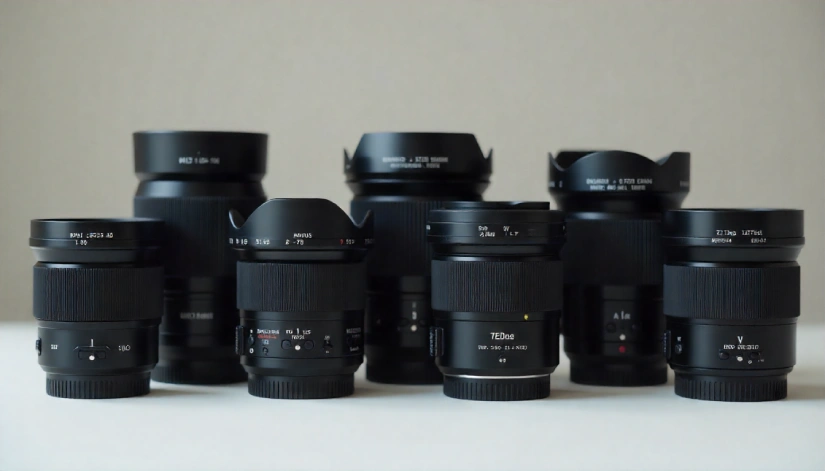
A Comprehensive Guide on Infra-Red Camera Lenses, Their Types, and Uses
Looking for an infrared camera lens to capture beyond the eyesight, something that is impossible to see. With the naked eye or even with standard camera lenses, trying to capture the imaging that is covered under fog, smoke, or is somehow restricted from vision. Technology has evolved and introduced an infrared camera lens, making it easier to capture what is even harder to see with standard lenses. These lenses are excellent in precision, especially in low-light or no-light situations.
In this comprehensive blog post, we will explore their types, such as the short wave infrared camera and thermal imaging camera lens, their differences, and what is unique in each of them. Let’s start the blog and explore its benefits and properties to understand each of them better.
What Is an Infra-Red Camera Lens & Its Benefits
An infrared camera lens is a lens that is specifically designed to capture infrared radiation, which cannot be seen with other lenses, cameras, or the naked eye. Their ability to capture infrared radiation offers the option to perform various tasks that are impossible with standard lenses. They are used for night vision, detecting heat signals, detecting cracks or defects, and measuring temperature. Therefore, this infrared camera lens is used in various industries, such as medical, construction, life sciences, surveillance security, and automotive.
They have a strong ability to produce high-quality images, including the detection of heat signatures, especially in low-light conditions. However, its personal use is limited to security and photography, as it produces unique images with color compositions. Resulting in breathtaking images captured by a professional photographer of scenery or objects.
Different Types of Infra-Red Camera Lenses
Let’s see the different types of infrared camera lens used in different applications, depending on the needs and characteristics of each application. The infrared lenses are typically divided into three categories. Let’s see them one by one.
1. SWIR Lenses
The SWIR stands for short wave infrared camera, which covers the wavelength range from 900 nm to 1700 nm. These wavelength ranges allow them to capture images within this range using cores and sensors for detection. They have the unique ability to offer high-contrast imaging even in low-light conditions by penetrating materials. These include smoke, fog, haze, dust, silicon, and other environmental interference, and contribute to the short wave infrared camera various applications.
These applications include industrial inspection in the food processing field, solar panel inspection, plastic sorting, and semiconductor manufacturing. Additionally, this expands to R&D, machine vision, material sorting, medical applications, security, process control, and transportation.
This short wave infrared camera is well-suited for 1064 nm laser source use, which enhances its versatility even further. These are designed for easy integration into wide imaging systems, as they offer a compact, lightweight design. Besides, they are excessively used for surveillance and security in low-visibility areas. As well as in imaging conversion and night vision operations.
2. Medium Wave Infra-Red Lenses
These infrared lenses improve the efficiency of capturing thermal radiation, such as infrared thermal imaging. It is used in high-temperature environments to detect visual changes related to temperature variations. Despite these exceptional properties, it is comparatively expensive because it requires cooling systems to operate efficiently. It has a 3000-5000 nm wavelength range and is used in applications of military training, scientific research, and gas detection.
3. Long Wave Infra-Red Lenses
These lenses are cost-effective, unlike MWIR, as the cooling is not required. These are the most effective of all the infrared lenses and produce infrared thermal imaging. Their ability to capture thermal images works even in heavy fog, making them highly effective in defense industry applications for high-level security and enemy identification. These have a wavelength range of 8000-14000 nm.
The infrared thermal imaging is a technology also known as thermal thermography that detects infrared radiation emitted by the temperature of objects. The images this lens produces are called thermograms, which represent temperature variation, and often use the color gradients to do so. Furthermore, any objects that emit thermal energy above zero can be captured by a thermal imaging camera lens, even when invisible to the naked eye.
Tabular Representation of Discussed Camera Lenses
This is a concise overview of the different infrared camera lens. So far, we have read starting with an infrared lens, followed by one of the popular types of short-wave lenses. Furthermore, the addition of the most famous type of lens, the thermal imaging camera lens, which operates in the LWIR, is highly effective at capturing infrared thermal imaging.
| Camera Type | Wavelength Range | Critical Properties | Key Characteristics | Applications |
|---|---|---|---|---|
| Infrared Camera Lens | ~700 – 14,000 nm | Broad coverage across NIR, SWIR, MWIR, LWIR | Captures radiation beyond visible light | Security, medical diagnostics, industrial inspection |
| SWIR Camera Lens | 900 – 1700 nm | High sensitivity to reflected IR light | Penetrates silicon, reveals hidden defects | Semiconductor inspection, material sorting, surveillance |
| LWIR Camera Lens | 8000 – 14,000 nm | Detects emitted heat radiation | Works in complete darkness, no external illumination needed | Thermal imaging for firefighting, medical heat mapping, night security |
It’s Time To Wrap Things Up
The infrared camera lens is indeed the best and most effective camera lens to use while capturing beyond-vision scenery. It overcomes limitations of natural weather, such as fog, smoke, and dust, to capture precise imagery. Additionally, provide thermal and temperature variation imaging with high quality, which is a top-notch feature to achieve with a single camera lens. Its ability to capture infrared thermal imaging is unbeatable and effective in dangerous situations, such as defense. If you’re looking for such effective lenses, check out the Superior CCTV website and get our products, which are robustly engineered to meet your specific needs.
FAQs
Ans: Yes, it is definitely possible to see through the materials that are opaque to visible light. Such features make SWIR cameras useful in the semiconductor industry.
Ans: The thermal imaging camera lens are built for LWIR heat detection, using specific materials like Germanium and Zinc Selenide to focus on emitted radiation.
Ans: Only transparent materials like Germanium, ZnSe, and Chalcogenide ensure clear imaging beyond visible light while capturing with an infrared camera lens. For such a high-quality product, visit Superior CCTV.