Get Precise and Innovative Smart Imaging Solutions for Modern Manufacturing
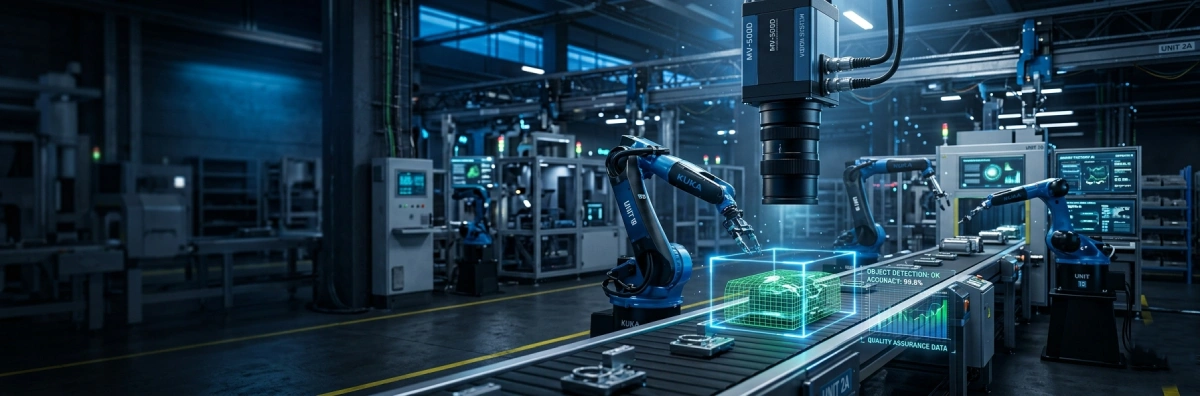
With innovation and advancement, manufacturing has become more automated than labor-focused, and the industrial cameras lens has become its pillar. It’s not just a cost-effective solution but also one that enables fast, on-time production and delivery, sometimes ahead of schedule. Meeting market demand and standards with the integration of automation in the production process. Thus, automation has a significant positive impact on modern manufacturing, offering substantial profit margins for innovative solutions.
Using high-quality lenses in smart engineering is crucial for this to function effectively. Because they not only perform basic surveillance but also provide precise system monitoring to ensure effective control of the automation. A minor fault can be the biggest source of turbulence, causing disruption throughout the whole manufacturing process. Moreover, this blog explores the importance of industrial cameras lens in modern manufacturing and more.
Industrial Lens: Foundation of Smart Manufacturing Process
Manufacturers engineer industrial camera lenses to produce high-resolution images. In addition to features that make it easy to use, adapt, and last longer, it can have a long-lasting effect. On production, it can be presented as a profitable solution. Let’s see the role of these in precision, durability, and adaptability.
- Precision: The resolution is clear enough that you can see the smallest details, proving that automation can carry it out thoroughly. Without interpretation and minor default.
- Durability: Manufacturing by the manufacturer and supplier, such as Superior CCTV, is robust and quality-focused. Therefore, the industrial cameras lens can last longer and be perfectly fine in different environmental conditions.
- Adaptability: The industrial camera lenses are highly optimized and advanced, featuring materials and designs that enable easy adaptability across multiple production processes. Whether it’s in the industrial sector, healthcare, optics, or elsewhere.
Mistakes to Avoid When Selecting Industrial Lenses
The selection of lenses is crucial, as it requires a professional, keen eye and a check of numerous parameters. Before selecting the one that best fits the needs, let’s look at some specifications that are often overlooked.
1. Solely Focus on Resolution
Resolution shouldn’t be a primary factor when choosing a lens because it doesn’t guarantee contrast. Additionally, edge performance is also ignored, and the real operating aperture is overlooked. A lens can deliver poor image quality in a shoot, even when the sensor resolution matches the paper. If the contrast and uniformity are insufficient. Therefore, evaluating industrial cameras lens and their overall image quality across the full field of view and under real working conditions is vital.
2. Assembly and Alignment Ignorance
Lenses can be extremely sensitive to small assembly errors, especially when alignment sensitivity is not considered. As the small decentration causes asymmetric blur, performance varies between units, making batch consistency difficult. Identifying it early is essential because, if it is integrated into production, the issues only appear afterward. Therefore, choose lenses designed with manufacturability and realistic tolerance in mind. While prefer to work with suppliers that precisely control alignment and centration.
3. Mechanical and Environmental Conditions
Industrial cameras lens are not suitable for ideal environments such as vibration, temperature variation, contamination, and long-term mechanical stress. Thus, its use during production line and lab operations can be distinctly different. Therefore, ensure that the lenses you are taking are mechanically structured and designed for industrial use, with sufficient stability and environmental protection.
4. Too much Dependency on Software Instead of Optical
Most often, it’s believed that software can fix the optimal problems, which is not true. Although the software is correct, powerful, and effective, it cannot compensate for poor optical contrast. In addition, unstable alignment and inconsistent distortion behavior. Thus, relying too heavily on post-processing often increases system complexity without solving the root problem. Therefore, prioritize optical and mechanical quality first, and optimize the software later on for fundamental correction.
5. Selection Without Considering Software Integration
In smart manufacturing, lenses should function as part of the system, not in isolation. Raising the problem with incompatible mounting interfaces, misaligned illumination geometry, and insufficient space for adjustment. If not chosen effectively, the issue can arise during integration, delaying the operation when signing and more. Therefore, it is necessary to evaluate it in advance using camera housing, lighting, mechanical fixtures, and a calibration strategy.
Specialized Imaging: Beyond Standard Industrial Lenses
Modern manufacturing systems demand more than just precision in optics, while industrial lenses set the backbone. Most setups require specific solutions, such as an infrared camera lens, to address unique challenges. Let’s see its uses and other lenses as well.
1. Infrared Cameras To See What Eyes Can’t
Infrared cameras are essential in environments where detecting heat signatures is required, while visual inspection falls short. They are used for:
- Predictive Maintenance: It identifies overheating components before failure, preventing faults and protecting products.
- Thermal Profiling: Provides uniformity in processes such as welding or curing.
- Non-Contact Inspection: Preferred in high-voltage or hazardous zones for pre-identification.
With its integration, manufacturers gain a layer of insight that standard lenses can’t provide, especially in a temperature-sensitive workflow.
2. Line Scan Lens Camera for Motion Precision
Line scan camera lens excel in high-speed and continuous production environments, where precision with speed is vital. It captures the image line by line, making it imperfect for:
Conveyor- Based Inspection: Textiles, packaging, and printing.
Defect Detection: Surface flaws, misalignments, or irregularities
High-resolution Imaging: Even with rapid speeds, clarity remains uncompromised
The lasers are engineered for consistency, making them indispensable in industries where throughput and accuracy go hand in hand.
Final Word!
The use of perfectly engineered lenses is not limited to surveillance. It also advances detection, providing accuracy, consistency, and speed. Industrial cameras lens are one of them, ensuring manufacturing is completed without any errors or faults while removing the drawbacks. Those manual processes used to address these issues have helped upgrade and advance the production line. That reduces labor risk, optimizes production, lowers costs, and ensures process uniformity.
Superior CCTV is a manufacturer and supplier that optimizes and customizes these sensors to meet product needs. With pre consultation to suggest design and customization as per needs. We ensure the product meets all our customers’ needs and even provide installation and post-service for any queries that customers have.
Frequently Asked Questions
Ans: No, a single sample doesn’t guarantee the production success; many problems can arise, like:
- During the multiple-unit assembly
- Tolerance accumulation
- Test made for long-term stability
Therefore, ask the supplier in advance how they ensure consistency across batches and how they verify performance beyond prototypes.
Ans: Some of the most asked questions to highlight the risk of the lesions can be:
- How can I control the centration and alignment of the lens?
- What’s the sensitivity level of these designs to assembly error?
- How can I ensure consistency in volume production?
Ans: Superior CCTV provides dedicated, responsive customer service to handle queries and provide post-purchase assistance to resolve any issues quickly. Whether you have a query regarding an infrared camera lens, industrial, or any other.
Ans: Superior CCTV offers many benefits that encourage customers to choose us, such as upscaling support for flexible needs. Bulk order processing, versatile solutions tailored to specific customer needs, distortion-free and high-quality imaging with superior build quality, and custom lens manufacturing.
Ans: The key factors to consider include the area size, the laser wavelength, the required precision, and the material type. Choosing the right lens ensures better performance, efficiency, and long-term reliability in laser marking systems.