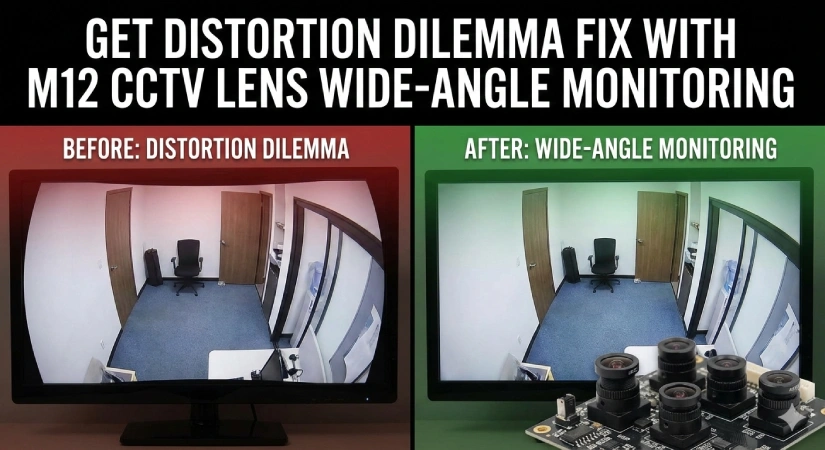
Get Distortion Dilemma Fix With M12 CCTV Lens Wide-Angle Monitoring
Security is critical to ensuring care and protecting spaces, and CCTV is the most effective way to support it. However, using a standard M12 CCTV lens often leads to common frustration among viewers of CCTV footage. The footage appears curved or warped, a phenomenon known as barrel distortion, which occurred solely due to the use of a standard lens. Although these CCTV cameras provide a wide viewing angle, which is essential for security, they often compromise the image’s geometric integrity. Therefore, the manufacturer has developed an advanced solution that delivers wide-angle coverage without sacrificing quality.
The advanced M12 CCTV lens is made from high-quality materials, including aspherical or multi-element optics. This build quality improves visibility, captures a wide field of view, and produces an image free of barrel distortion. In this blog, we will explore a barrel-free solution for surveillance monitoring. The manufacturing of a lens that provides this perfect image and its application.
Manufacturing Engineering: Advanced Lens Vs. Standard Lens
While capturing a large field of view, the camera must compress a wider area onto a small sensor using a standard M12 lens. But with the introduction of advanced lenses of M12, the funhouse mirror effect can be avoided while capturing the wide FOV. An M12 lens is a compact threaded lens module commonly used in CCTV and embedded vision systems. In standard lenses, the M12 wide-angle design allows higher magnification at the center and decreases towards the edges, introducing barrel distortion. Uneven magnification results in a stretched, bowed-out image.
High-quality design uses specialized glass elements, often aspherical or multi-element, to pre-correct the curvature of light rays in a CCTV lens. It shapes the path of light coming towards the sensor and ensures that straight lines in the real world remain straight in the captured image. The discussed optical correction occurs inside the lens, so the sensor receives a geometrically faithful projection. Making it suitable for precision applications like machine vision, robotics, and inspection, where distortion would compromise accuracy. Here are the two lenses used to capture the change in scenery.
1. Standard Spherical Designs
Standard spherical lenses are mostly wide-angle lenses that use spherical glass elements in the camera to capture images. Now, due to this design, while capturing these bent light rays more aggressively at the edges and the center. Usually, the magnification drops as you move away from the optical axis, so straight lines curve outward (classic barrel distortion).
2. Rectilinear Designs
The rectilinear design is used on advanced lenses to reduce barrel distortion. It is engineered to project straight lines in the scene as straight lines on the sensor. Which helps form an image without a curve. The rectilinear design employs a complex combination of glass elements and, in some cases, aspherical surfaces to counteract the natural bowing effect. These advanced approaches and complex designs preserve geometric accuracy across the entire field of view, producing a straight image.
Application of Advanced Lenses: Where Geometry Matters Most
A M12 board lens for CCTV camera used in professional surveillance monitoring requires image geometry that isn’t just aesthetic. But it is more oriented toward the professional accuracy captured by the camera. Consider retail environments or warehouse logistics where professional surveillance is needed to monitor the large aisles and wide storage units. In more detail, these spaces are defined by long, straight lines: aisles, shelving units, and conveyor belts. A standard wide-angle lens creates blind spots at the edges of the frame by bending lines of sight. These blinding spots are where theft frequently occurs.
By using a specialized CCTV Lens, the security manager can maintain a wide Field Of View (FOV) in the straight shelving units. These will allow managers to have precise monitoring of stock and staff movement. Furthermore, accurate geometry is critical to modern AI analysis, as facial recognition software and object-tracking algorithms rely on precise spatial data. If a person’s features are captured in a distorted area by these lenses, the software may fail to identify them correctly. In contrast to a residential setting, where the peephole effect is acceptable because subjects are near the center.
Why Pixel Clarity Matters: Safeguard Evidenced Integrity
Integration of an advanced M12 mount CCTV camera lens is vital in ecosystems where safety and theft protection are the baseline. Without these lenses, footage distortion will only undermine justice, as identity based on high-speed or identity recognition can’t be reliably verified. But with an advanced precision-engineered M12 board lens, the pixel carries accurate spatial data. Low-distortion lenses aren’t just about aesthetics. They also support applications such as forensic accuracy and reliable security monitoring.
Wrapping It Up!
The use of an advanced M12 CCTV lens ensured that you could capture a wide-angle image with low to zero distortion. It eliminates the need to sacrifice a wide viewing angle to achieve a flat, realistic image. For security managers or warehouse owners, it’s high time to check your CCTV camera setup and see whether straight lines are turning into curves. It is time to upgrade your CCTV surveillance system with an advanced, low-distortion lens. If you’re making up your mind for an upgrade, don’t forget to visit the Superior CCTV page. We offer multiple options for the advanced M12 CCTV lens. Our professional will also be able to guide you if you have any confusion.
FAQs
Fisheye distortion, or barrel distortion, is caused by a lens’s inability to capture images at the edges of the frame. Because the lens is trying to capture a wider area than the sensor is flat, the image must be squeezed at the edges to fit, causing such phenomena. Thus, the straight line appears to be curved, particularly near the frame borders.
Yes, in most cases. If your camera utilizes an S-mount, you can unscrew the existing optics and replace the low-distortion lens without any trouble. However, you must match the sensor size format (e.g., 1/2.7″ or 1/3″ ) to the new lens. It is ensured that the image circle covers the sensor without vignetting or cropping.
Standard lens captures the wide angle while curving the frame at the edge of the image, producing a cheap view. A rectilinear lens uses more complex glass elements to correct its curvature optically. Thus, the image is captured correctly. It is ensured that vertical and horizontal lines (like door frames or walls) appear straight, even at the edges of the video.
AI software relies on pixel accuracy to identify objects, read license plates, or recognize facts. Thus, capturing spatial imaging becomes essential. Heavy distortion warps these features, which makes it extremely difficult for algorithms to process the data accurately. A low-distortion lens presents the AI with a “flat” image, significantly improving detection rates and reducing false alarms in your systems.
The full length (measured in mm) determines our zoom and angle. A lower number (e.g., 2.8mm) gives a wide view. While a higher number (e.g., 12mm) zooms in. For wide-angle monitoring without distortion, look for lenses with a low focal length that are specifically labeled as “low distortion” or “rectilinear.”