How F-Theta Lenses Deliver Perfect Flat-Field Focus in High-Speed Laser Marking?
Laser marking is one of the fields that requires extreme accuracy. Even a single-point mistake can be very harmful during real-world implementation. The F theta lens is the optics that are used for this precise accuracy and careful implementation. These lenses are chosen above standard lenses because standard lenses create a curved focal plane with galvo scanners. On the other hand, the f-theta lens solves the issue, and it also addresses flat-field focus, distortion, and positioning accuracy. Therefore, the theta lens is the first choice for application, especially in laser marking systems.
This blog is the perfect guide for engineers, machine vision integrators, laser system OEMs, and manufacturing quality managers. This will be a perfect, F theta lens in-depth guide that walks you through the uses of f-theta in high-speed laser marking. Additionally, exploring the concept of its perfect flat-field delivery during laser marking.
What are F-Theta Lenses and Why Standard Lenses Fail in Laser Scanning?
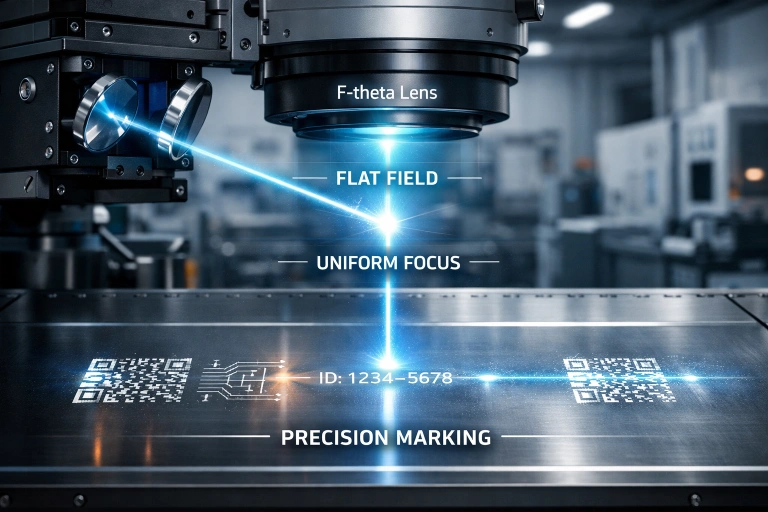
An F-theta lens is a scan lens especially engineered to work with galvanometer (galvo) mirror systems. It works in laser marking, engraving, cutting, and additive manufacturing applications. The f-theta lens is optimized by many manufacturers to project a moving laser spot onto a flat work surface. With uniform focus and minimal distortion, unlike standard imaging lenses designed for capturing images. The name f-theta originated from a mathematical relationship between focal length (f) and scan angle (θ), which goes image height = f × θ. These engineers ensure that the lens has a predictable spot when the laser moves and a proportional distance on the workpiece.
A few of the available laser wavelength ranges of the f-theta lenses:
- 355nm (UV): For fine marking on glass, ceramics, and sensitive materials
- 532nm (green): For marking reflective metals and high-contrast applications
- 1064nm (near-infrared): The standard for fiber lasers, most versatile across metals and plastics
- 10.6µm (far-infrared/CO₂): For organic materials like wood, leather, acrylic, and paper
| Parameter | Standard Telecentric Lens | F-Theta Scan Lens |
|---|---|---|
| Focal Plane | Curved (field curvature present) | Flat across the entire scan field |
| Edge-to-Center Focus Variation | ±10–30% spot size change | <±2% spot size variation |
| Distortion | Barrel/pincushion (3–8%) | <0.1% (F-Theta corrected) |
| Scan Field Utilization | ~60–70% usable before blur | 95–100% usable area |
| Positioning Accuracy | Requires complex software correction | Linear by design (minimal correction) |
| Ideal Application | Static imaging, inspection | Galvo-based laser marking/cutting |
Applications of F-Theta Lenses Across Industries
The applications of f-theta lenses are narrow but focused, and they significantly impact applications. Each industry where the use of the f-theta lens is used improves that work by increasing the speed and efficiency of the whole process. It’s the one and only industrial cameras lens where such precision and deduction is required.
1. High-Speed Laser Marking and Engraving
Precise, high-speed laser marking and engraving are performed on the machines. It is done to ensure that the models, codes, their unique identities, and the engraving and marking are applied perfectly. Such serialization is performed on automotive VINs, medical device UDI codes, and electronic part numbers. It can write up to 1000 plus characters per second with consistent quality, ensuring the engraving provides readable codes and traceability compliance.
2. Laser Cutting and Micromatching
The second application comes in the form of a focused laser beam used to cut or remove thin layers of material. It is essential for making tiny, precise parts in medical devices such as stents and catheters, as well as in electronics such as flexible circuits. The precise laser beam ensures the cutting depth is consistent without needing to adjust up and down (the Z-axis). It is possible with the f-theta lenses, which would have been hindered by using the SWIR fixed focal length lens. Even though it provides a high-resolution capture of scenery.
3. Additive Manufacturing (SLS/SLM)
Its application in 3D printing involves fusing a powdered material (metal or plastic) into layers using a laser. Here, it is used to build larger parts up to half a meter with just one set of optics. The laser spreads energy evenly, so the printed part has consistent density and strength throughout. You can use it to make strong, complex parts for industries such as aerospace, automotive, and medical implants.
4. 3D Surface Structuring
3D surfacing refers to the creation of controlled textures and patterns on a surface during manufacturing. Meaning the dashboard panels, grips where both aesthetic and texture feel matter, and in making medical instrument grips to ensure the tools don’t slip during use. These are the perfect examples of 3D surface structuring. It ensures uniformity across large flat areas and creates a texture that is consistent and free of irregularity, so the product won’t look or feel uneven.
5. Barcode and QR Code Marking
With the rise of digital payments, barcodes and QR codes are the most common things we come across. However, making them is uncommon. It’s rather complicated and requires laser or precision marketing of machine-readable codes. The barcode, QR code, and data matrix codes are all created as small as 2mm × 2mm. These are extremely critical as 0.5% distortion can make the code unreadable. Therefore, a critical requirement such as a positioning accuracy of ±10µm is needed to ensure compliance with ISO/IEC standards and enable the scanner to read codes.
It’s Time To Wrap Things Up!
Laser marking and engraving are critical industries that require laser-focused work from lenses, as even a slight mistake can be disastrous. The F theta lens dominates the industry of laser marking due to its accurate and reliable delivery. With the integration of f-theta lenses, it’s not just the work efficiency that increases, but the speed of work also increases. You can cover large areas to engrave code and unique numbers with uniform focus, the same width, color, depth, and texture of the engraving. Apart from just laser industries, other industries also prefer this option for speed, precision, and quality, as nothing is compromised.
Choosing the right option of optics, which is the F theta lens, improves marking results. Laser marking with f-theta lenses is a smart, long-term solution that delivers effective results without delay. If you’re looking to buy this, look no further than Superior CCTV. We are one of the best suppliers and manufacturers of f theta lenses, and we offer these optics at the best prices. Additionally, we have a support team that can guide you in choosing.
Frequently Asked Questions
Ans:
It’s an optics used to make the work easier and more effective in the laser-making field. The F-theta lens is a special optical lens that provides stability to the laser beam, focusing it and spreading it evenly across the surface. Thereby, the accuracy, consistency, and high-quality marking in industrial applications are ensured.
Ans:
These are essential because they maintain a uniform spot size and focus across the marking field. Allowing industries to achieve precise, fast, and reliable results when used without any distortion or uneven engraving.
Ans: Yes, f-theta lenses are widely used across industries. Starting with electronics, automotive, medical devices, packaging, and even jewelry. Their ability to deliver speed and accuracy makes them suitable for many industrial marking applications.
Ans: The F-theta lens maintains a consistent laser beam across the marketing field, ensuring sharp, precise results. While UV lenses capture fine details for inspection, f-theta lenses directly enhance marking accuracy and clarity in production.
Ans: The key factors to consider include the area size, the laser wavelength, the required precision, and the material type. Choosing the right lens ensures better performance, efficiency, and long-term reliability in laser marking systems.