Telecentric or Fixed Focal Length Lenses: Making the Right Choice for You
The lenses play the most critical role across many areas of work, beyond security surveillance, such as measuring entities and ensuring precision in imaging applications. A telecentric imaging lens is one of the products that work and is widely used due to its excellent feature of capturing precise images. While telecentric lenses are one solution, fixed-focal-length lenses are also an excellent choice for the same purpose. They are good enough to be considered among the top choices for high-resolution image capture. The best way to decide which one is your perfect optics is to clearly understand their core functionality.
Therefore, this blog explores both lenses’ functionality and provides brief details regarding the lenses. After this blog, you can understand their work, what they do, and how precisely they capture the imaging. Then you can decide between a telecentric imaging lens and a fixed-focal-length lens, whichever suits your requirements. This is your guide to clarifying how choosing the right lens impacts measurement accuracy, image quality, and its Return on Investment.
Understanding the Telecentric Lens: What makes it Unique?
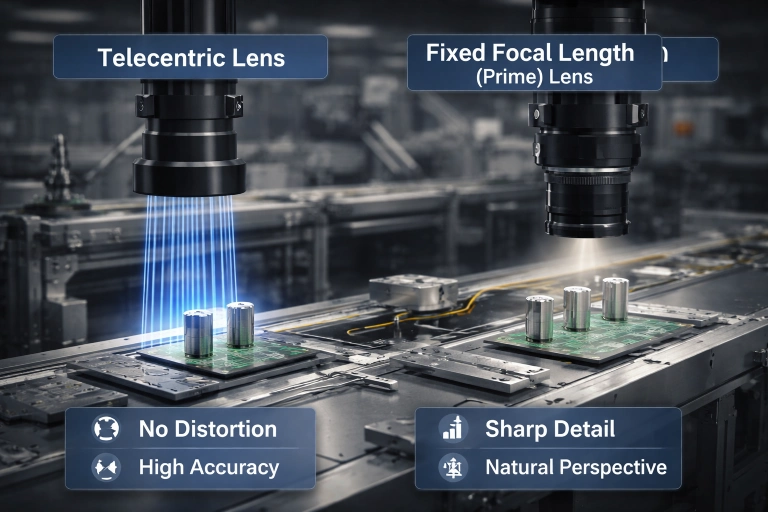
A telecentric lens features specialized optics, whether in the objective or in the camera, and offers magnification to infinity. It is possible due to its entrance or exit pupil attaching to it at infinity, so the image distance and angle don’t affect the final result. The magnification of the C mount telecentric lens makes this lens such an excellent choice to use across industries. It captures objects without being affected by the distance between the two objects or by the distance from the lens to the object. The property of never compromising image quality and angle of view is called telecentricity. Two of its extremely important characteristics are: Parallel light rays and Constant Magnification.
The core advantages of telecentric imaging lenses are as follows:
- The top-most quality of telecentric lenses is that they offer zero-perspective error, meaning the object appears the same size regardless of its position within the working distance. It is the critical factor for precise dimensional measurement used in many applications. Eliminates measurement variations caused by object placement.
- It delivers high-resolution imaging with exceptional contrast and sharp edge detection for precise boundary measurement. Causing minimal aberration.
- Premium telecentric lenses achieve <0.1% distortion in imaging and have accurate geometric measurements. Reliable for metrology applications.
- Parallel light rays of telecentric lenses maximize backlighting effectiveness, resulting in superior silhouette imaging. Highly ideal for inspecting transparent or translucent objects.
What Are the Fixed Focal Length Lenses? Brief Explanation
A fixed focal length lens is also called a prime lens, which is composed of only one fixed focal length, e.g., 25 mm. These are single and unchangeable, but they capture great images with high resolution and clarity. The optical design is extremely simple, with fewer moving parts and fewer glass elements. Its simple design allows light to pass through it in a straightforward path, reducing distortion and aberrations from the captured images. However, it does offer an option to optimize them for sharpness, contrast, and minimal optical flaws at that specific focal length.
A fixed focal length lens is often compared to or mistaken for the functionality of Zoom lenses. However, there are some differences: zoom lenses have various focal lengths and can be adjusted according to needs. Additionally, they feature a complex optical design with more moving parts. Using this, one can capture images at different magnifications by simply adjusting the lenses. Some key advantages of fixed lenses include:
- The fixed lenses are also cheaper and super budget-friendly, costing 40-70% less than telecentric lenses. This makes them great options, as they offer better ROI for general inspection purposes.
- Moreover, the flexibility in installing the lenses is amazing, as they can be adjusted for different working distances. The lenses can also be adjusted to different fields of view to suit the application’s needs.
- The fixed lenses are compact since they have a smaller mounting footprint. It reduces the mounting requirements.
- The camera’s better light-gathering ability with larger aperture options (f/1.4 to f/2.8) improves performance even in low light. The camera can have faster shutter speeds.
- The variety of focal lengths also improves image quality, as the range is wide. The lenses can be used for 2D or 3D object images since they are versatile. The focal lengths available are 8mm to 75+ for C-mount.
Decision-Making Framework Through Comprehensive Lens Selection Table
After understanding the functionality of both cameras, it’s time to compare them through major criteria. So you can identify your high resolution lenses and can decide which one to choose based on the application requirements. The table below contains a few selection criteria and a side-by-side comparison of both lenses. You can choose from here or do even further research, or take the help of a professional who can guide you.
| Selection Criteria | Telecentric Imaging Lens | Fixed Focal Length Lens | Winner For |
|---|---|---|---|
| Measurement Accuracy | Exceptional (<1% error) | Good (1–3% typical) | Precision metrology |
| Perspective Error | Zero | Increases with distance | Dimensional measurement |
| Magnification Consistency | Constant across depth | Varies slightly | Repeatable measurement |
| Cost | High ($800–$5,000+) | Economical ($100–$800) | Budget projects |
| Size/Weight | Large, heavy | Compact, lightweight | Space-limited installs |
| Working Distance | Fixed, limited range | Flexible positioning | Versatile setups |
| Light Efficiency | Lower (small aperture) | Higher (large aperture) | Low-light conditions |
| Depth of Field | Shallow but consistent | Variable with aperture | Adjustable applications |
| Resolution | Excellent for flat objects | Excellent overall | Application-dependent |
| Setup Tolerance | Requires precision | More forgiving | Easy installation |
| Backlighting Performance | Superior | Adequate | Silhouette inspection |
| Field of View Options | Limited by magnification | Wide range available | Large area coverage |
It’s Time To Wrap Things Up!
There is no functionality in any optical lenses that can be integrated to make it a universal solution for surveillance and other uses. The right choice, whether a telecentric imaging lens or a fixed lens, is determined only by the work you want to use these cameras for. Whether it’s for surveillance, machine use, capturing measurements and geometry, or perfect imaging. Telecentric lenses can be ideal for precision measurement and for imaging where a consistent magnification requirement is vital. On the other hand, fixed focal-length lenses are great for use cases that require versatility, cost-effectiveness, and excellent imaging for general applications.
Choose the one that fits your preference and application requirements based on these critical factors. Accuracy requirements and working distance flexibility. Furthermore, the choice is either a telecentric imaging lens or a fixed focal length lens that also fits the budget and meets the object characteristics. If you have any further queries, you can always seek advice from the Superior CCTV experts. We have experienced people to help. They can guide you and make suggestions after learning your preferences and needs.
Frequently Asked Questions
Ans: It is recommended not to because it can introduce vignetting in images. Telecentric lenses are designed for specific sensor sizes, and using a larger size will result in darkened corners and reduced image quality. It can compromise the lens’s precision advantages.
Ans: It features a shallower depth of field in telecentric while maintaining constant magnification throughout the depth of field. However, fixed lenses offer variable depth control via aperture adjustments, and magnification ranges vary slightly.
Ans: We provide documents such as comprehensive CAD drawings, optical specifications, MTF charts, distortion data, and compatibility guides. Additionally, our technical team provides integration support, including mounting recommendations and illumination configuration assistance upon request.
Ans: Yes, we do provide evaluation programs for qualified applicants. You can test lenses in your production environment for 14-30 days to ensure their performance meets your requirements before committing to a purchase.
Ans: All lenses include a standard two-year warranty covering manufacturing defects. We offer lifetime technical support, including application troubleshooting and optical performance verification. Ensuring warranty options are available for mission-critical installations.