
Comprehensive Guide On F-Theta Lenses, Their Use In Laser Applications
The f theta lens provides precise engraving and marking of specialized components that deliver a desired result across the working area consistently.
In this, the theta lenses play the role of a critical element that transforms the working of a laser system. At the same time, the theta lens focal length also plays a major role in its practical work while working on laser systems. Whether you’re working with fiber lasers, CO2 Systems, or UV sources, understanding how these different laser systems improve their work is essential. With a use of a theta lens can significantly improve your output quality and operational efficiency.
The name “F Theta” comes from the mathematical relationship that defines its operation. In standard lenses, the image height follows a tangent function. However, an F Theta Lens is engineered so that the image height equals the product of the lens focal length and the scan angle (h = f × θ). This linear relationship ensures predictable, uniform marking regardless of where the laser beam strikes the work surface.
This comprehensive guide on the theta lens explores the aspects of its technology, from basic principles to advanced applications. In this blog, learn about all the factors that help achieve efficient results with the theta lens focal length, and more. Unlike conventional lenses that produce curved focal planes, this unique lens creates a perfectly flat field of focus across the entire scan area.
What are F-Theta Lenses?
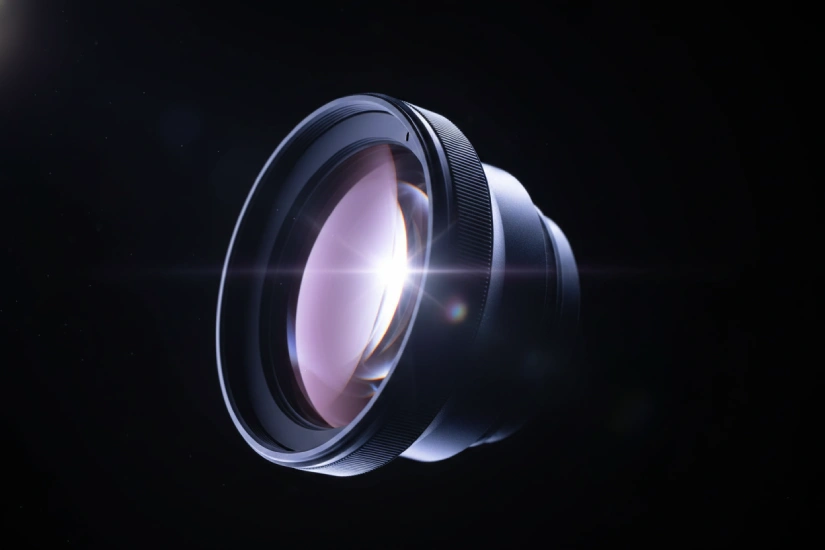
The f theta lens is a specialized optical component designed to focus a laser beam onto a flat image plane with a uniform spot size, ensuring consistent scanning across the entire field. This f theta lens, also known as the flat-field or scan lens, is primarily designed for use in applications such as laser systems, laser machining, cutting, engraving, and scientific imaging. It uses two-axis galvanometers for object scanning and operates according to the image plane angle. With the addition of barrel distortion, the f theta lens becomes an excellent choice.
These diffraction-limited lenses can also be customized according to application needs. They performed the customization based on factors such as wavelength, focal length, and spot size. As a result, the distortion will not exceed 0.25% across the entire field of view, thanks to the laser lens focal length. This serves industries such as electronics manufacturing, automotive production, medical devices, fabrication, and engraving.
How Focal Length Works with Optics in F Theta Systems
Understanding the focal length optics is imperative for optimizing the performance of a laser system. The defining factor of many critical parameters depends on the lens focal length, which includes working distance, spot size, and field dimensions.
Science Behind Focal Length
In laser scanning systems, the light enters the f theta lens system after the galvanometer mirror directs it. Only then does the lens focus this beam onto the work surface while maintaining the unique linear displacement characteristics. The relationship between the focal length laser directly influences how the energy is concentrated on the material.
Therefore, when selecting the laser lens focal length specifications, operators need to balance multiple factors. A shorter lens focal length produces a smaller spot size, which enables finer details but has limitations on the screen area. Conversely, a longer focal length expands the working field but decreases precision.
Key Formula and Relationships
The fundamental equation for calculating the focal length optics in these systems is:
Image Height (h) = Focal Length (f) × Scan Angle (θ)
The above formula explains why the focal length laser selection directly results in determining your working area dimensions. For example, a 160mm lens with a specific scan angle produces a proportionally sized field compared to a 254mm lens under identical conditions.
Furthermore, the spot-size relationship is equally important. As the laser lens focal length affects beam concentration according to this formula:
Spot Diameter ∝ (Focal Length × Wavelength) / Input Beam Diameter
Now, understanding the focal length optics principles makes it easy for the operators to select appropriate lenses for their applications and material requirements.
F Theta Key Features and Benefits
The modern design of the f theta lens has multiple features to enhance the laser system’s performance. Here are the essential characteristics of their components.
1. Flat Fields Correction
Maintains a uniform focus height across the entire work area, which eliminates edge distortion, a common issue with conventional lenses.
2. Consistent SpotSize
Proper selection of the laser lens focal length yields an identical beam diameter from the center to the periphery, ensuring uniform marking quality and depth.
3. High Transmission Rate
Quality units achieve 99%+ transmission, minimizing energy loss and maximizing laser efficiency during operation.
4. Linear Image displacement
Optimized focal length optics design provides a predictable scanning behavior in applications where precise material processing is needed.
5. Anti-Reflective Coatings
Multi-layer coatings enhance focal length laser performance while protecting against thermal damage during extended operations.
6. Multiple Lens Focal Length Options
Available in various laser lens focal length configurations ranging from 100mm for micro-marking to 500mm+ for large-area processing applications.
7. Wavelength-Specific Designs
Each lens focal length variant is engineered for optimal focal length laser performance at specific wavelengths, including 1064 nm (fiber), 10.6 μm (CO2), and 355 nm (UV).
Comparison of F-Theta Lens Focal Lengths
Selection of the perfect laser lens’s focal length requires a clear understanding of specifications for focal length optics. Translate into real-world performance of these lenses. The following table provides a comprehensive comparison of standard configurations to help users align their choices across technical and other fields with practical applications.
| Lens Focal Length | Working Area | Spot Size | Working Distance | Best Application |
|---|---|---|---|---|
| 100mm | 70×70mm | ~25μm | 119mm | Fine engraving, micro-marking |
| 160mm | 110×110mm | ~40μm | 184mm | Standard marking, barcodes |
| 254mm | 175×175mm | ~65μm | 287mm | Medium-area processing |
| 330mm | 220×220mm | ~85μm | 372mm | Large surface marking |
| 420mm | 300×300mm | ~110μm | 458mm | Industrial cutting, wide-area work |
Conclusion!
The f theta lens is the foundation for the laser system. However, it is important to understand its working principles and how it affects other important components. Anything related to lens focal length requires the theta lenses to work efficiently. After the thorough understanding of their feature and qualities, make sure you integrate this into your work and enhance your production process.
If you have made an informed decision about getting these lenses, visit the Superior CCTV.