Beyond Eyepiece Lens: High-Performance Optical Choice for Scientific Use
The eyepiece lens are located at the top of the microscope, which helps in magnifying the image captured by the objective lens. It is simply used to magnify the image so that the individual at the other end can see it. The image captured by objective lenses can be expanded into a beautiful, clear image, with magnifications of 10x, 15x, and even 20x. These are used before the eyepiece lens on a microscope and are used to identify the specimen and other objects they are trying to observe. The eyepiece lens further magnifies this image, allowing the user to get greater detail.
Both lenses, the eyepiece and objective, play a major role in clear picture formation for greater detail. At first, the objective lenses magnify the image entering the objective and focus it into a sharp, clear image. Then, the eyepiece lens takes the light focused by the objective lens and magnifies it further to produce a clearer, more detailed image. In this blog post, we will explore these two lenses, their function types, and their differences. So you have a better understanding.
What are Eyepiece Lenses, and their types?
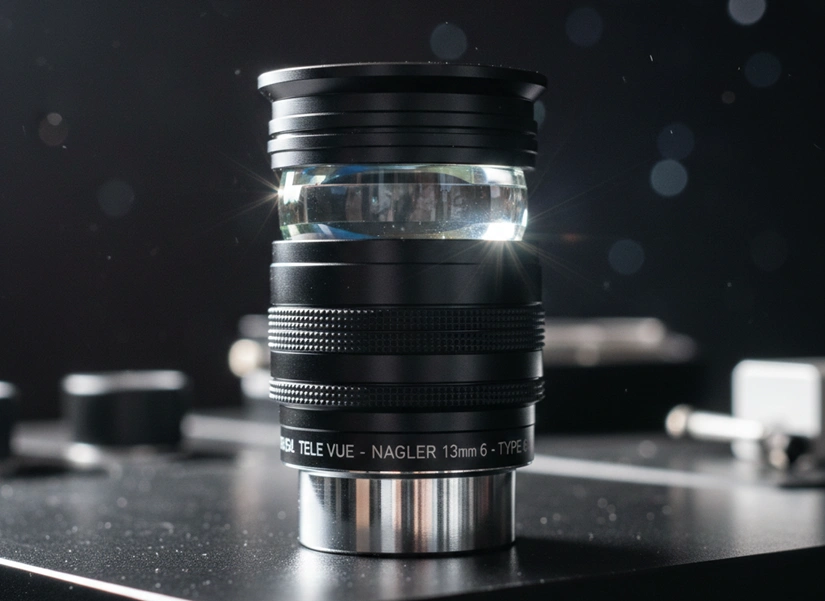
The eyepiece lens, also commonly known as the ocular lens, is a magnifying lens that provides greater image detail. It is located at the top of a microscopic tube, is removable, and offers the insertion of various other eyepieces with varying magnifying capabilities. The eyepiece lens microscope is positioned just above the nosepiece (which revolves) and the objective lens. It serves as the second lens in the setting of a two-lens system of a compound microscope. It also works after the object lens has magnified the specimen image, the eyepiece lens microscope further magnifies this image.
Together, these two lenses help achieve the total magnification of the image essential for the detailed examination. The eyepiece consists of multiple components, which help it work efficiently. It has a lens element (multiple), a lens barrel (a cylindrical structure that houses and holds the lens element in place), and a reticle.
Here are a few types of eyepiece lens on a microscope and their variations:
1. Huygenian Eyepiece
It is also called a negative eyepiece. Thus, it’s the simplest negative-eyepiece lens design, offering great magnification from 5x to 40x. Therefore, it is widely used in laboratory microscopes.
This eyepiece lens microscope has two lenses:
- Upper Lens: This is placed near the observer’s eyes, called the eye lens.
- Lower Lens: This lens, known as the field lens, is placed near the diaphragm.
Both of these lenses have a fixed circular distance from the midway point between the object and the image.
2. Ramsden Eyepiece
This eyepiece lens on a microscope is the simplest high-resolution lens, but it’s a positive one. In this, similar to a Huygenian lens, the eye lens and the field lens are kept in plano-covex form. While the field lens is kept with its curved surface facing toward the eyepiece lens. Therefore, it produces sharp, clear images and is widely used in astronomical and scientific telescopes. The image projection can vary with changes in focal length.
3. Wide-Field Eyepiece
The wide-field eyepiece uses additional lens elements to produce a comfortable, broader viewing field.
4. Compensating Eyepiece
This eyepiece lens microscope corrects any optical aberrations, so the image quality produced has enhanced quality and clarity.
What Is an Objective Lens? Its Types, Function, And Properties
Objective lenses are the primary lenses, the ones closest to the captured image in a microscope, and are like the microscope’s eyes. These microscope objective lenses work superbly at capturing a magnified image by collecting light from the specimen (the tiny image you want to see). Furthermore, they magnify the image to display greater detail with transparency.
An objective lens can make a small object look clearer and more prominent. Depending on the number of lenses used to magnify it (e.g., 4x, 10x, 40x). The microscope objective lenses limit of magnification increases, and the lens enlarges the object’s image. In addition to these objective lenses, determine how sharp and clear the image will be, which is called resolution.
Here are the different types of objective lenses:
1. Low-power
Magnification Range: From 4x to 10x
Uses: The microscope objective lenses are used to observe larger specimens and to locate areas of interest for higher magnification after obtaining a general overview of the sample.
Characteristics: A Larger lens with lower power of magnification, wider field of view, and a short length compared to others.
2. Medium-power
Magnification Range: From 20x to 40x
Uses: Gives a detailed examination of specimens, from studying cell structures to smaller microorganisms.
Specifications: These microscope objective lenses are medium-sized and have moderate magnification, offer a balance between resolution and magnification, and produce precise, detailed images compared to low-power lenses.
3. High-power
Magnification Range: From 40x to 100x or more
Uses: Detailed examination of small structures is performed using microscope objective lenses, which help study individual cells and bacteria.
Characteristics: A small lens with high magnification power, a higher numerical aperture that gives better resolution and quality. Careful focus and handling are required due to higher magnification.
How to Select the Right One for Your Needs
In the above explanation of the eyepiece lens and objective lenses, we have gained a clear understanding of what they are and how they enhance image quality and help us see finer details in images under a microscope for further research. Here are a few considerations to help you decide whether you need an eyepiece lens on a microscope orthe objective lenses.
1. Optical Correction
Achromatic, apochromatic, plan, and semi-plan objectives correct image distortions. Plan objectives give flatter, clearer views (80%), while semi-plan provides moderate correction (65%), improving image quality across the field.
2. Numerical Aperture
NA measures how much light an objective gathers. A higher NA means the eyepiece lens microscope produces brighter, sharper images with better resolution, which is crucial for viewing fine details or weak signals in fluorescence microscopy.
3. Working Distance
WD is the space between the objective lens and the specimen cover slip. Higher NA reduces WD, so powerful objectives require closer positioning, which affects usability and specimen handling.
It’s Time to Wrap Things Up!!
The eyepiece lens, together with the objective lens, helps form images in the microscope at a much higher magnification. This has resulted in various critical applications, such as research on microorganisms in different fields. If you have understood their uses and want to improve work efficiency, get the eyepiece lens from one of the most trusted lens manufacturers, Superior CCTV.